作为国内领先的二手车流通科技平台,有辆科技应邀参会,集中展示在 AI 智能车况检测、二手车跨境流通领域的落地成果,与行业同仁共探机动车拍卖创新融合、国内二手车出海发展新路径。
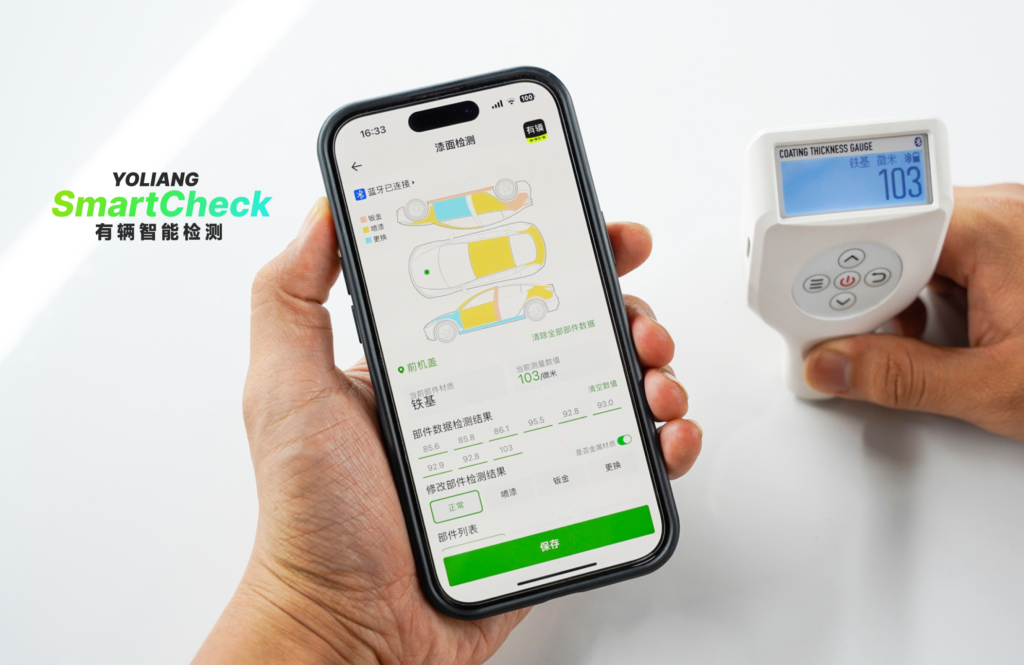
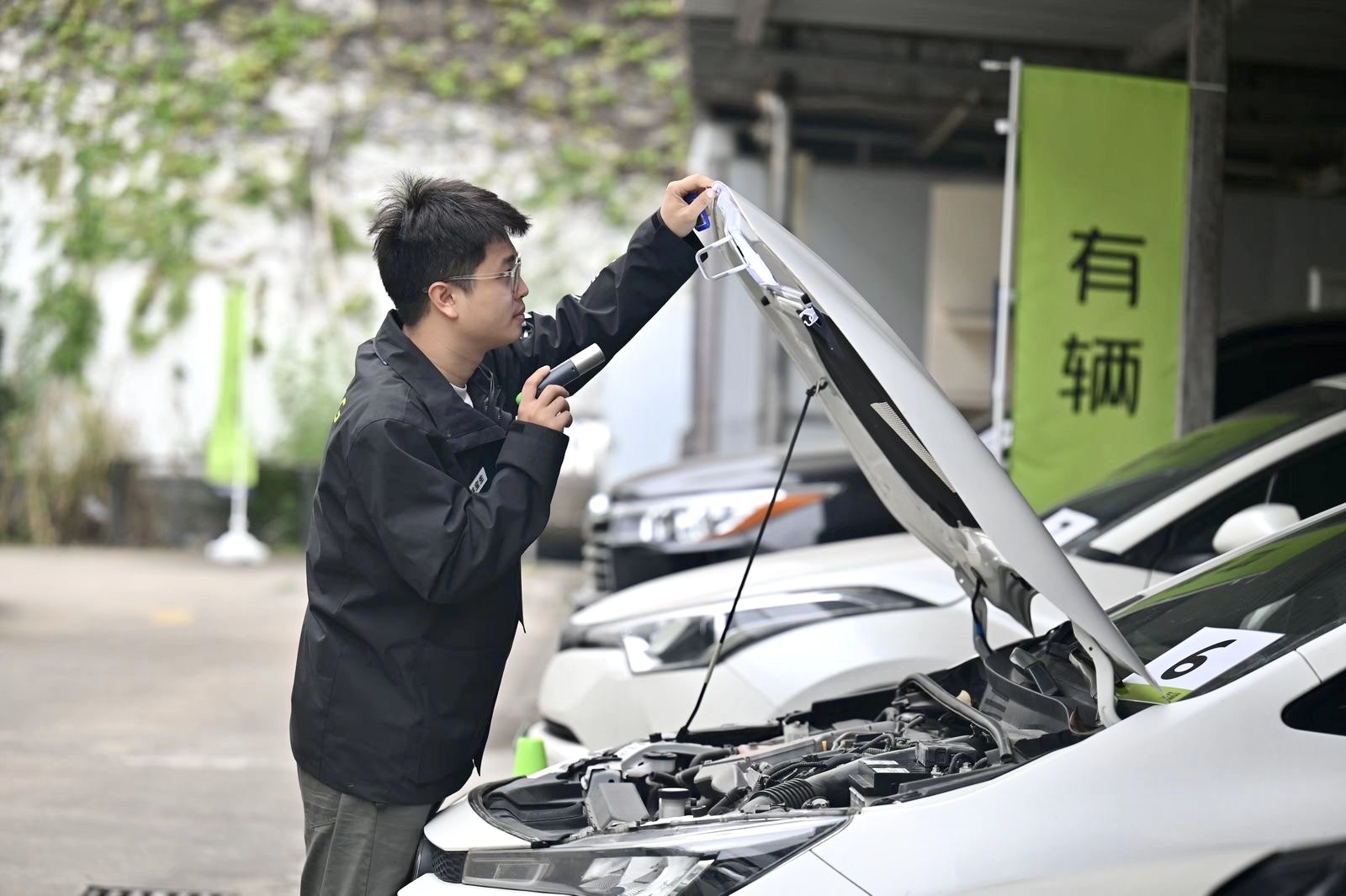
依托持续的技术研发投入,有辆智能检测 Yoliang SmartCheck 已在主机厂、大型经销商体系规模化落地。该系统融合 AI 车况分析算法与 IoT 物联网硬件,可显著提升二手车车况检测的准确度,压缩检测耗时,帮助经销商降本增效,为二手车拍卖、置换处置业务筑牢车况数据根基,目前已被越来越多车企与经销商集团采用。
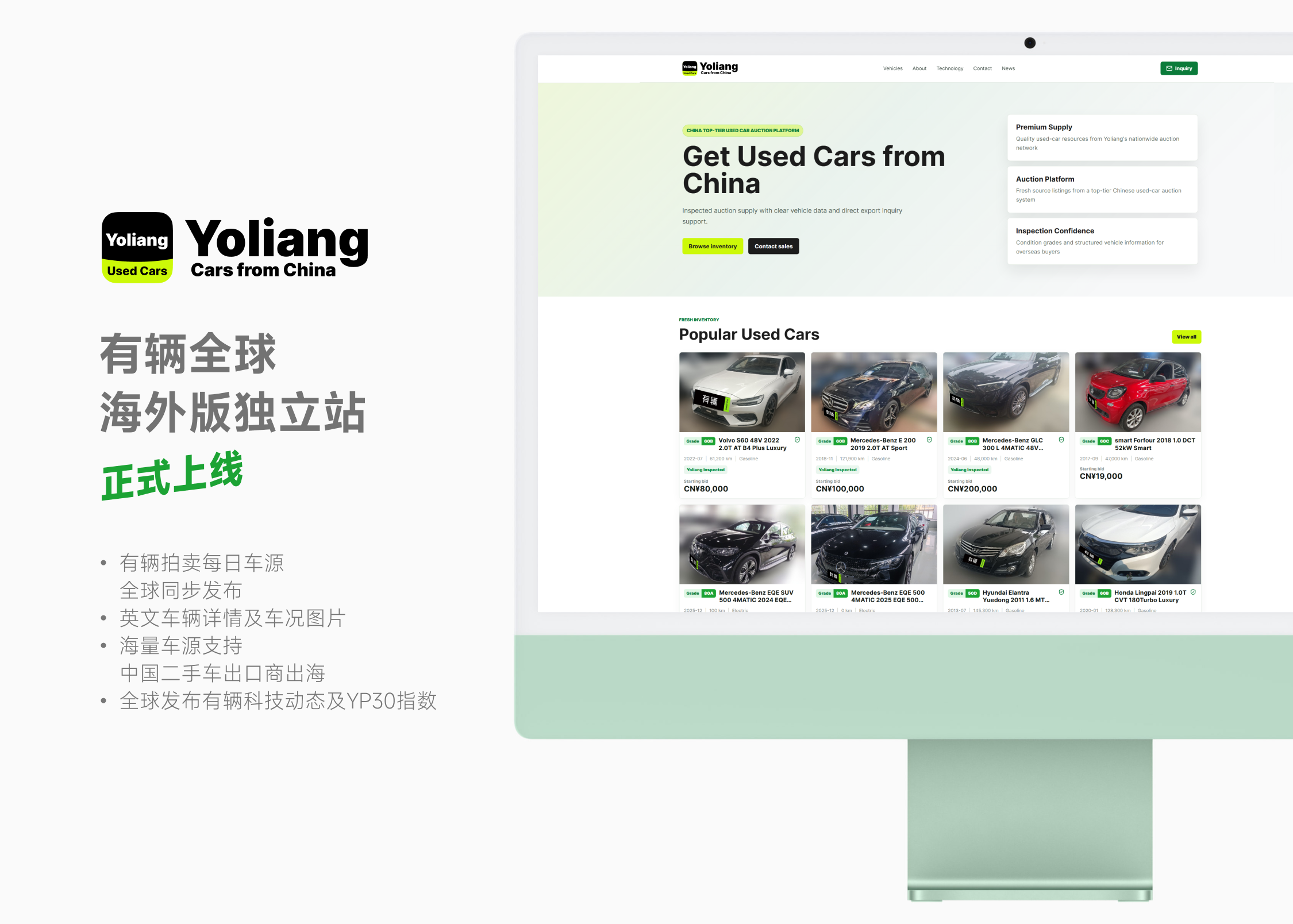
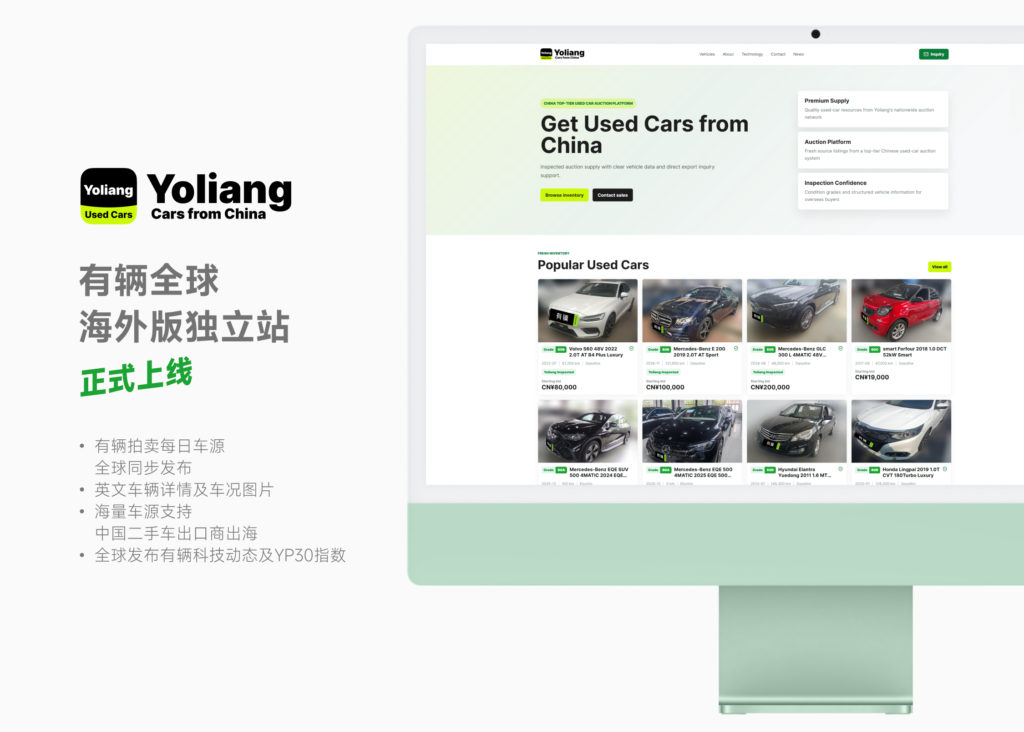
在海外业务布局方面,有辆科技打造的全球版独立站 Yoliang Global 上线后持续获得海外二手车经销商关注,逐步成为西非、中东、中亚、东南亚等地区海外客商采购中国二手车的重要线上选车渠道,助力国内优质二手车资源出海,打通二手车跨境流通链路。有辆全球版独立站,正在通过车源高效的信息流通、透明的车况、清晰的交易链路,助力中国二手车提高国际竞争力,与此同时中国二手车出口商也将有辆拍卖作为采购车源的重要渠道。
September 2026 YP30 Index Report: Price Declines Slow Significantly as Used Vehicle Market Enters a Structural Bottoming Phase
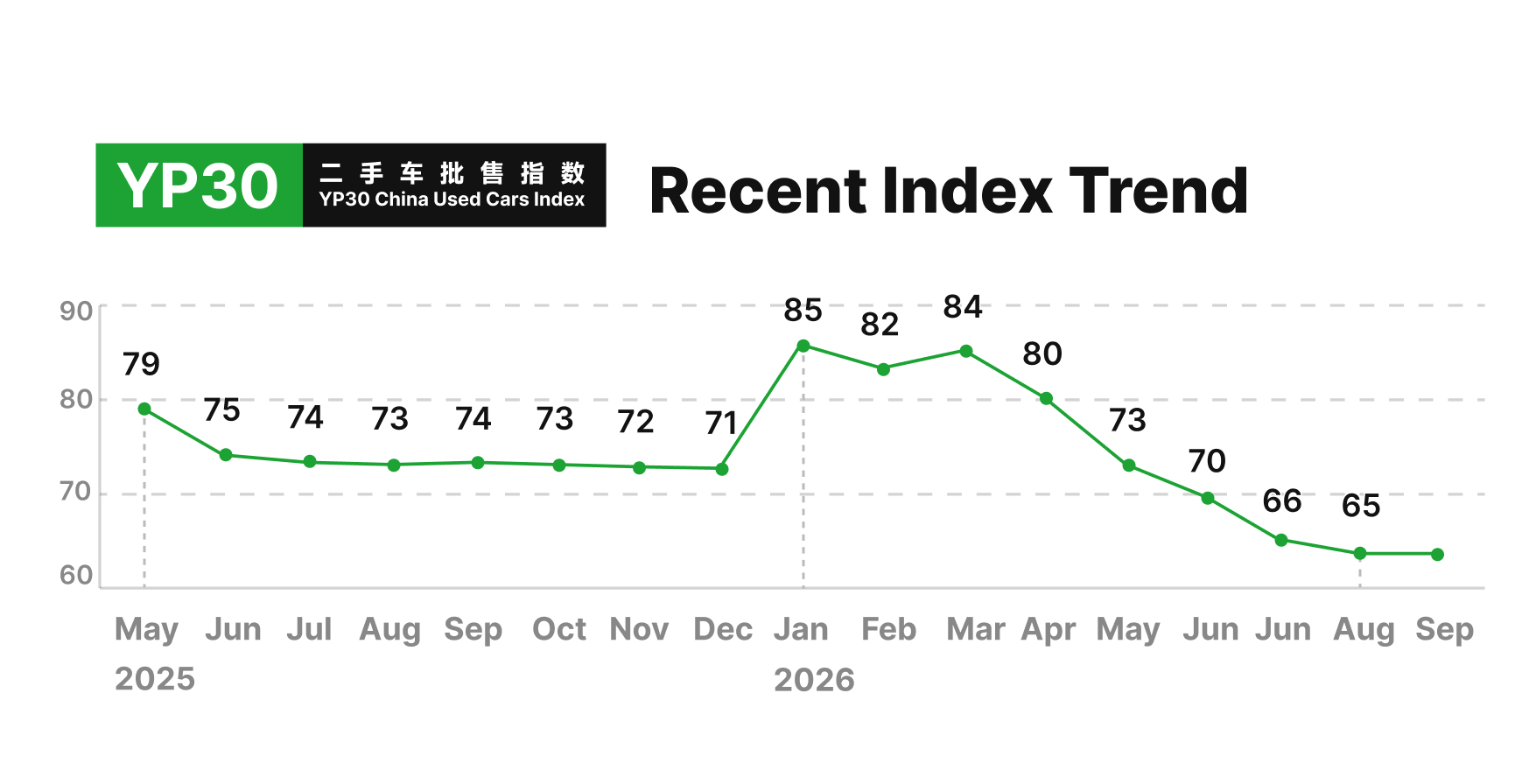
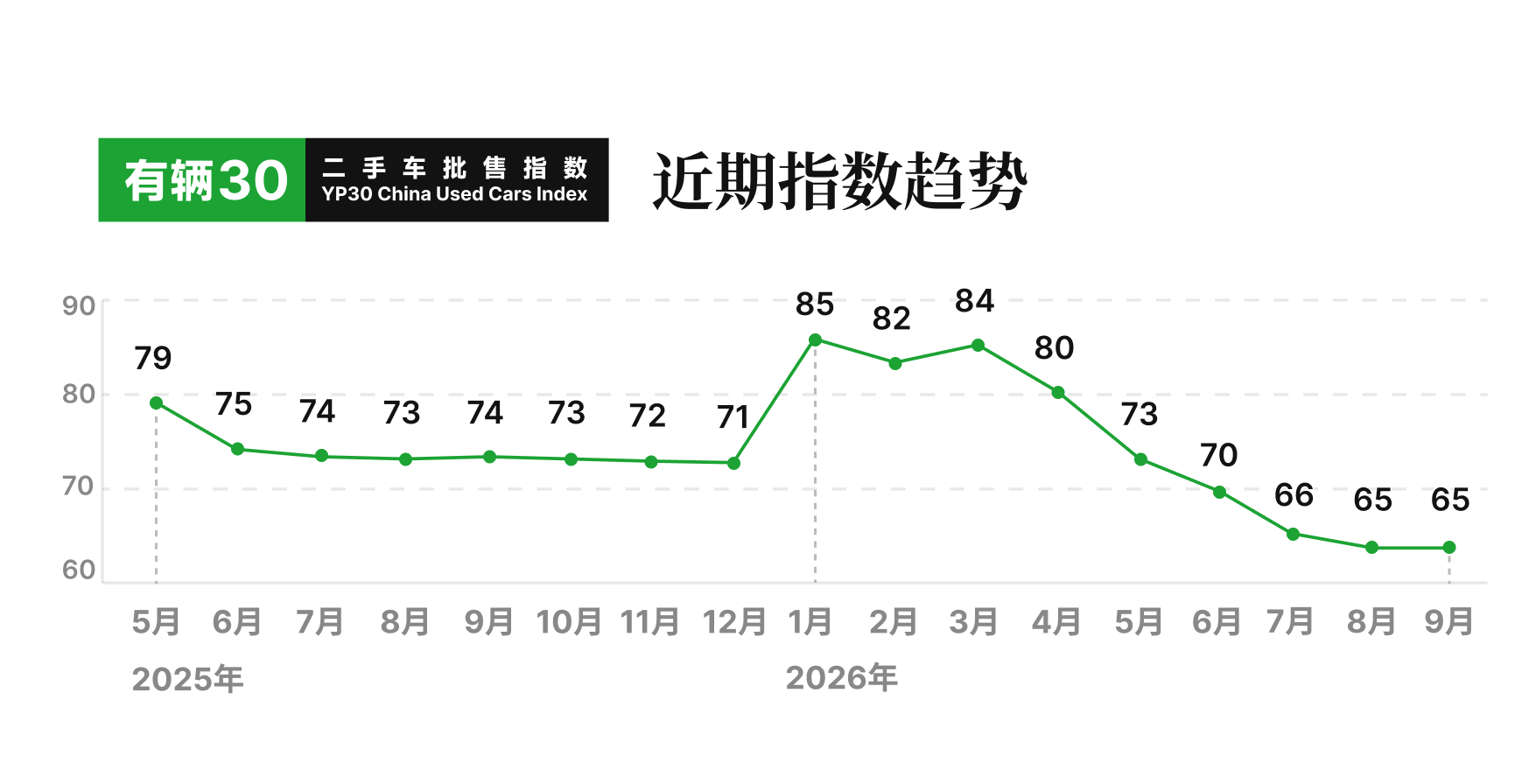
The Yoliang Company has released its September 2026 Yoliang 30 Used Vehicle Wholesale Price Index (YP30) report. The index remained at 65 points in September, broadly unchanged from August. The market has moved beyond the previous phase of sustained, sharp declines, with downward price pressure continuing to ease. The industry is entering a new phase characterized by tentative bottoming and increasing structural differentiation.
Market performance in July and August also pointed to a gradual moderation in price declines. As market sentiment begins to recover and September marks the traditional autumn peak season, trading confidence has shown signs of improvement. However, there is not yet clear evidence of a broad-based market rebound. The industry remains in a cautious recovery phase, with performance varying significantly across vehicle segments.
Macroeconomic Context: Used Vehicle Demand Remains Resilient
In the second half of 2026, the dynamics of China’s new and used vehicle markets continue to evolve. Used vehicle transactions have remained relatively stable, with used vehicle transaction volume equivalent to approximately 98% of new vehicle sales. China’s automotive market is increasingly entering a phase in which new and used vehicles coexist as major components of the overall market.
Continued price concessions in the new vehicle market and rising new energy vehicle penetration are placing sustained pressure on the valuations of used internal combustion engine vehicles. At the same time, used vehicles continue to benefit from their affordability and flexible circulation channels, absorbing replacement demand and demonstrating resilience. These factors provide underlying support for market stabilization.
Price Trends: From Broad-Based Declines to Structural Differentiation
The Yoliang 30 Index reached an annual high of 84 points in March 2026 before declining through the following months. The pace of decline moderated in July and August, with August recording the smallest monthly decrease of the year. In September, the index stabilized, indicating that near-term downward pressure had eased considerably.
The market is not yet experiencing a broad-based recovery. Instead, it is shifting from widespread price declines toward structural differentiation and selective recovery. Price performance varies substantially by vehicle type, segment and brand, creating divergent opportunities and risks for used vehicle dealers.
Vehicle Types: Sedans Remain Resilient, While SUVs and MPVs Face Continued Pressure
Price performance across vehicle types remained notably differentiated in September.
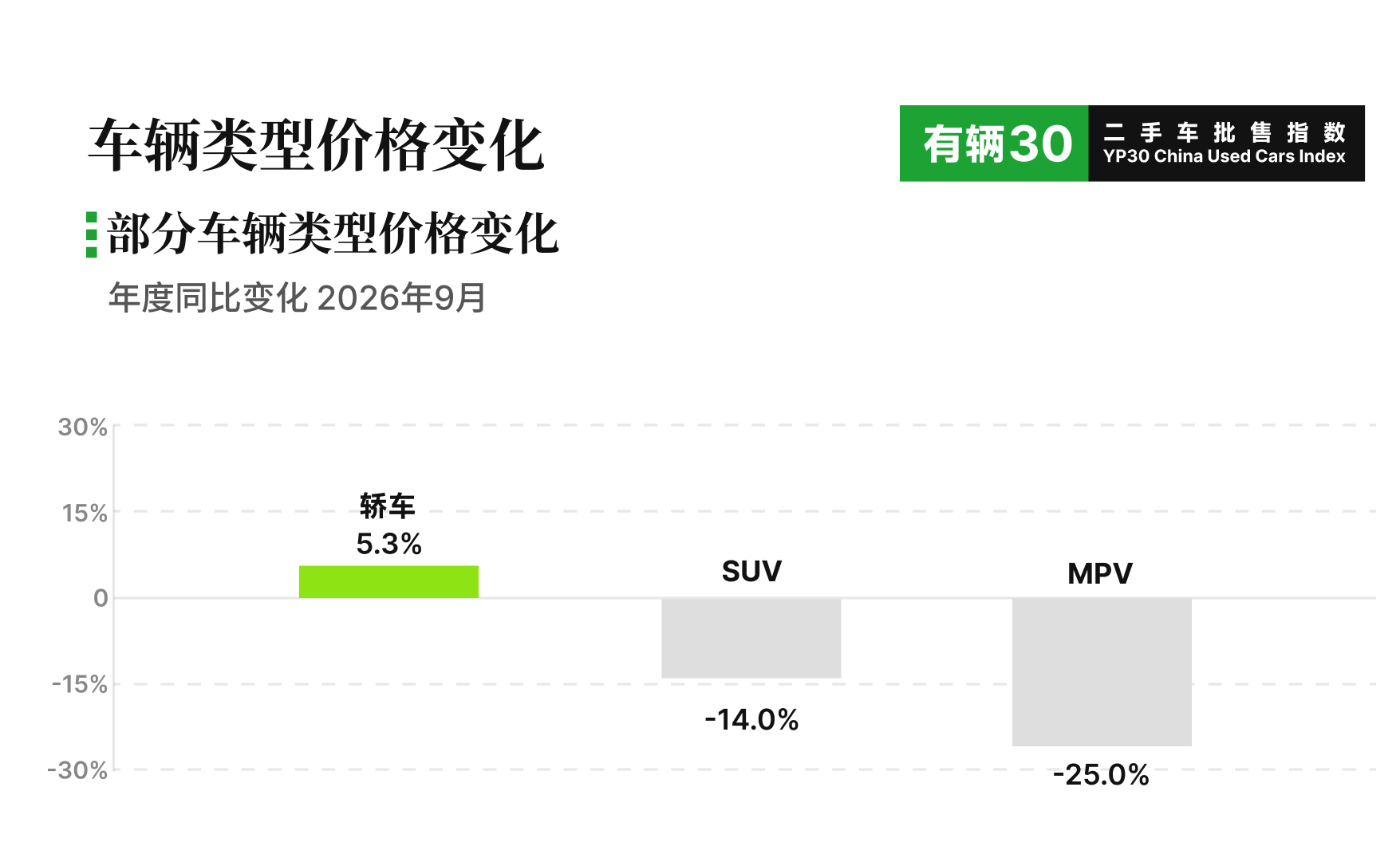
Sedans were the most resilient category, with prices rising 5.3% year over year. Their broad customer base, relatively high turnover and stable demand make mainstream passenger cars a comparatively defensive inventory choice for dealers.
SUVs and MPVs continued to face pressure. SUV prices fell 14.0% year over year, while MPV prices declined 25.0%. Factors include continued price cuts in the new vehicle market, changing household mobility needs and abundant existing inventory. Residual values for larger business-oriented and multipurpose family vehicles are recovering more slowly, leaving these categories relatively exposed to market risk.
Vehicle Segments: Strength at Both Ends of the Market
Data by vehicle segment show a distinctly polarized pattern in September.
Micro and mini vehicles used for everyday mobility performed particularly well, with prices increasing 42.4% year over year. Demand for affordable transportation and low-cost vehicle ownership continues to support this segment, which also benefits from relatively efficient inventory turnover.
Larger and premium used vehicles also recovered, with prices rising 34.0% year over year. This reflects a gradual recovery in high-end replacement demand and improving valuations for premium vehicles in good condition.
Small and compact vehicles recorded modest gains, while mainstream midsize vehicles remained broadly stable, with limited price movements.
Overall, demand and purchasing activity are increasingly concentrated at two ends of the market: highly affordable vehicles for everyday mobility and premium vehicles in good condition. Mainstream family vehicles in the middle of the market are entering a more stable phase, with neither strong upward nor downward momentum.
Brand Origins: Chinese Brands Gain Ground as Valuations Recover
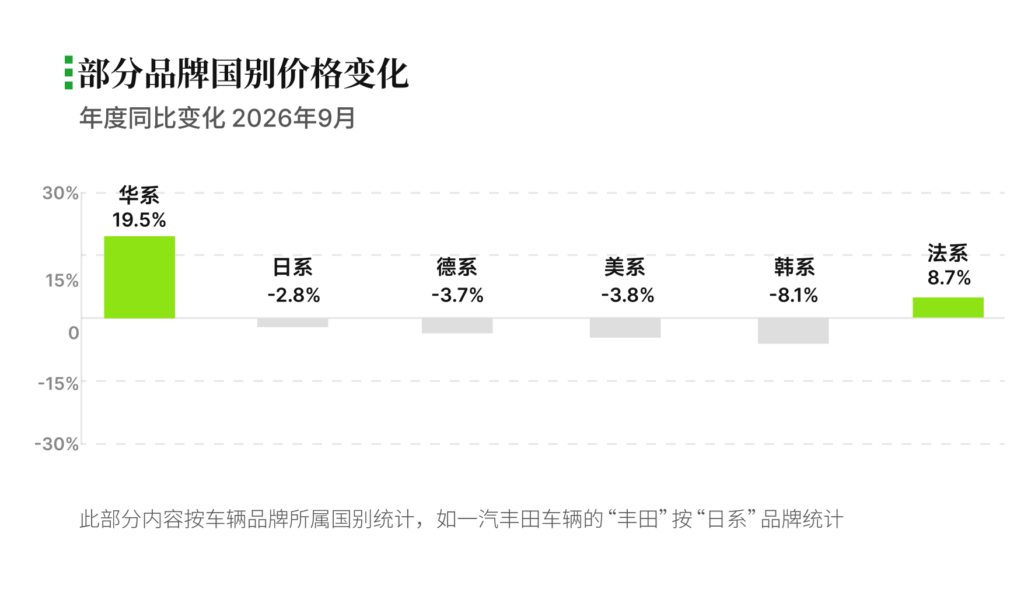
The brand valuation landscape underwent a notable shift in September, with Chinese domestic brands recording a strong recovery.
Used vehicles from Chinese brands rose 19.5% year over year, outperforming other brand-origin categories. Continued advances in new energy vehicle technology, a growing vehicle population and improvements in after-sales service are supporting stronger residual values and consumer acceptance of Chinese vehicles. This signals a gradual reshaping of a valuation landscape historically dominated by joint-venture brands.
French brands also performed relatively well, rising 8.7% year over year. Japanese, German and American brands recorded modest declines, while Korean brands faced the greatest pressure, with prices falling 8.1% year over year.
The changing performance of domestic and joint-venture brands represents one of the most significant structural developments in China’s used vehicle market in September.
Cross-Regional Circulation: Strong Northern Demand, with Central China Gaining Momentum
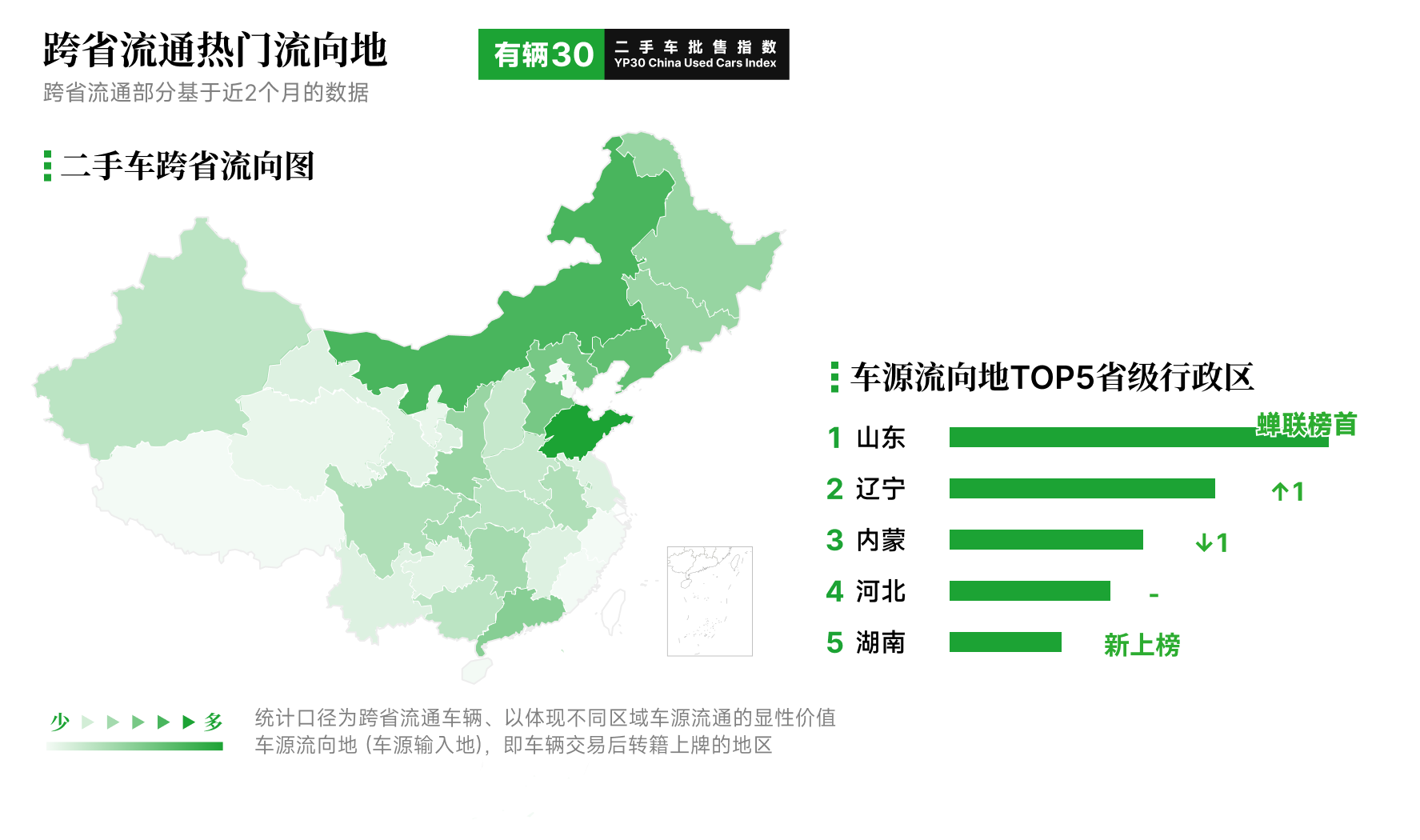
Interprovincial used vehicle circulation remained active, helping balance differences in supply and demand across China. Over the past two months, the top five provinces by vehicle inflows were Shandong, Liaoning, Inner Mongolia, Hebei and Hunan.
Shandong remained the country’s largest vehicle-inflow market. Demand across northern China remained strong, particularly for family-oriented internal combustion engine vehicles and practical everyday cars. Hunan entered the top five, indicating growing purchasing demand in central China and a further expansion of the national used vehicle circulation network.
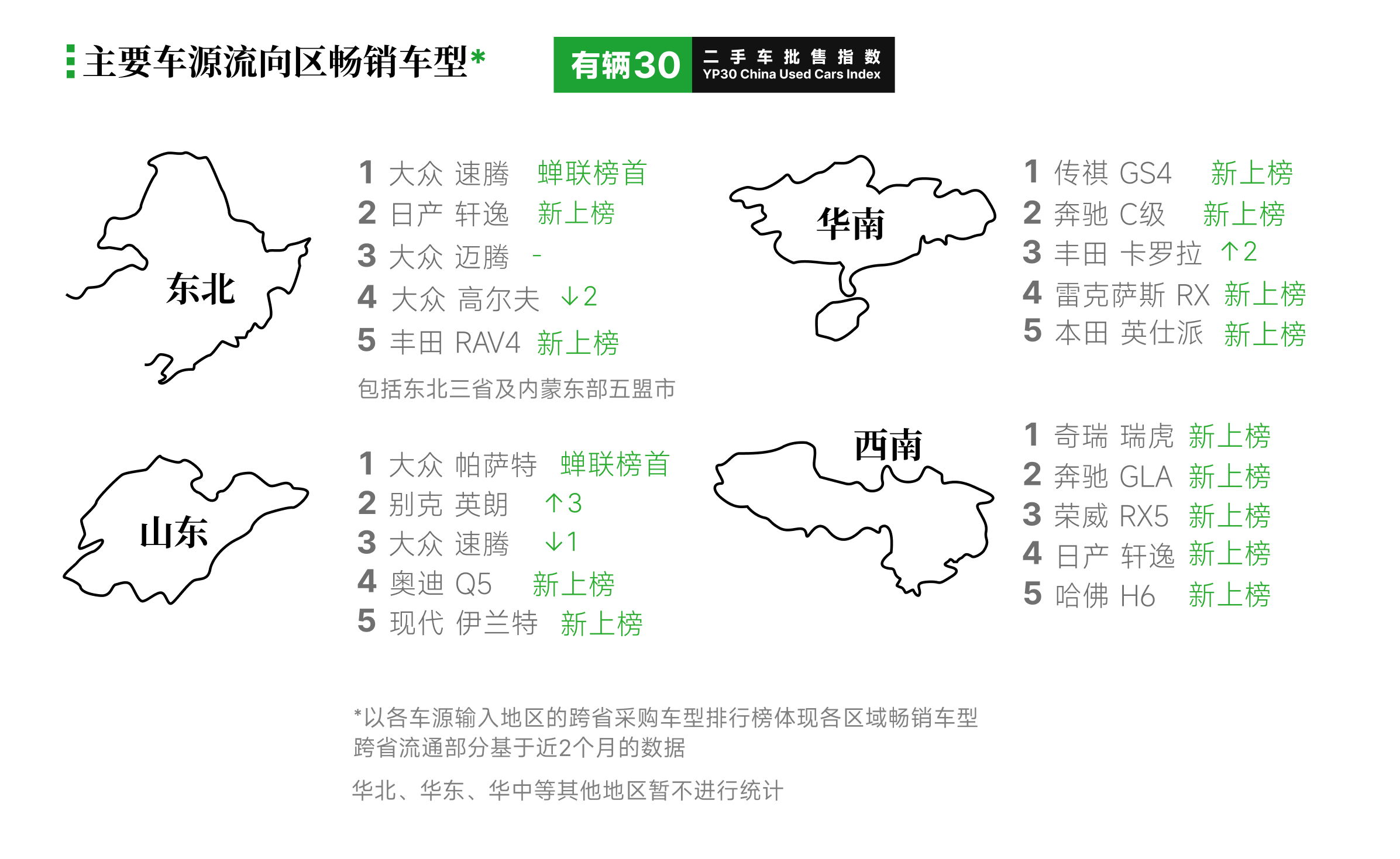
Popular models also reflected distinct regional preferences:
Northeast China: The Volkswagen Sagitar remained a leading model, supported by established demand for German family cars, while Japanese SUVs continued to gain traction.
Shandong: The Volkswagen Passat maintained a leading position, highlighting the continued importance of mainstream joint-venture family vehicles.
South China: Domestic and luxury brands performed well, with the GAC Trumpchi GS4, Mercedes-Benz C-Class and Lexus RX among the region’s popular models.
Southwest China: Domestic SUVs gained traction, with the Chery Tiggo, Haval H6 and Roewe RX5 recording stronger circulation performance.
These regional differences continue to support nationwide used vehicle liquidity by connecting inventory with markets where demand is strongest.
Exports Provide Additional Support as Digital Channels Connect Global Markets
As China’s domestic used vehicle market undergoes structural adjustment, exports continue to provide an additional source of demand and support residual values in selected segments.
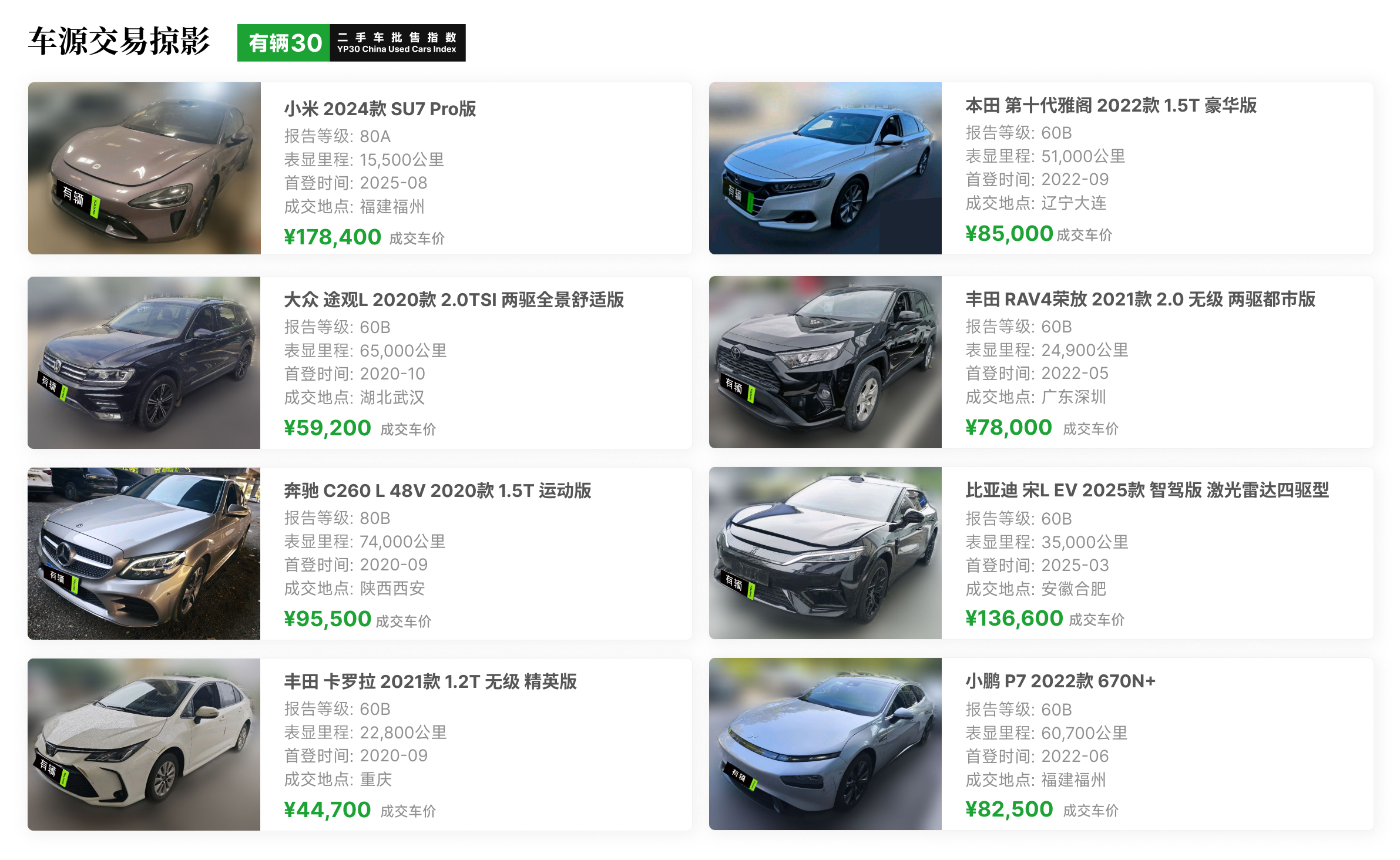
China’s used vehicle exports maintained steady growth in July and August. Demand continued to emerge from Central Asia, Russia, Southeast Asia, the Middle East and Africa. Overseas orders remained active for compliant, affordable internal combustion engine vehicles and high-quality used new energy vehicles. Export demand helps absorb domestic inventory, ease supply pressure and support prices in selected segments.
Although exports alone are unlikely to generate a broad-based price recovery across the entire domestic market, they help improve the balance between supply and demand and contribute to a more stable market adjustment.
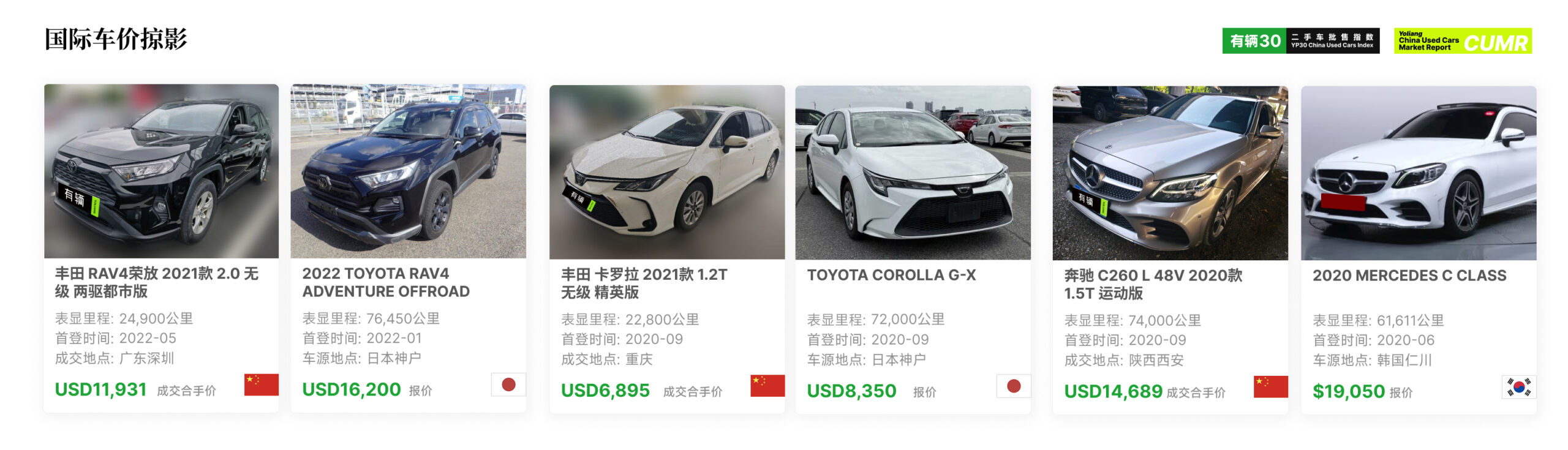
Against this backdrop, The Yoliang Company continues to develop its digital cross-border services through Yoliang Global, its independent international platform. The platform provides international buyers across multiple countries with round-the-clock access to used vehicle inventory in China, including actual auction listings, vehicle-condition records, photographs and relevant documentation.
By improving access to vehicle information and reducing information gaps in cross-border transactions, Yoliang Global helps overseas buyers evaluate and select vehicles remotely. It also enables Chinese exporters and wholesalers to connect more efficiently with international buyers, supporting more efficient cross-border circulation and the international expansion of China’s used vehicle trade.
September Market Insights and Outlook
Taken together, market data from July through September and broader economic developments indicate that China’s used vehicle market has moved beyond the period of sharp declines and entered a phase of tentative bottoming, structural differentiation and cautious recovery. The easing of price declines and the arrival of the traditional autumn peak season have helped improve business confidence.
Nevertheless, a sustained upward turning point has not yet been established. New vehicle price competition, elevated inventory in certain segments and uneven recovery in consumer demand continue to weigh on the market. A broad-based rise in used vehicle prices is therefore not yet supported by current conditions.
Several segment-specific opportunities are becoming clearer. Micro and mini vehicles, larger premium vehicles and used vehicles from Chinese domestic brands have demonstrated stronger price performance or residual-value resilience. By contrast, dealers should remain cautious when stocking traditional SUVs, MPVs and weaker-performing joint-venture brands.
As the traditional September–October peak season progresses, continued implementation of vehicle trade-in programs and the release of replacement demand could help improve inventory turnover and strengthen the foundations for a gradual recovery.
Overall, September 2026 was characterized by slowing price declines, bottoming-out movements, structural differentiation and incremental support from exports. China’s used vehicle market is moving away from a broad-based downward adjustment toward a new phase focused on optimizing existing inventory and drawing on both domestic demand and international markets.
Whether the market can establish a sustained rebound will depend on the combined signals from transaction volumes, inventory turnover, new vehicle pricing strategies and export orders in the months ahead.
AboutYoliang
The Yoliang Company is a technology-driven used vehicle circulation services platform focused on improving the efficiency and transparency of used vehicle transactions. Its business spans used vehicle auctions, vehicle inspection, transaction data services and cross-border used vehicle circulation.
The Yoliang 30 Used Vehicle Wholesale Price Index (YP30) tracks wholesale price movements across 30 mainstream vehicle models, using Yoliang’s transaction data and analytical methodology to provide market reference information for industry participants.
Translation Disclaimer: This English version is a translation of the original Chinese-language article. It is provided for reference and international communication purposes only. In the event of any discrepancy or inconsistency between the English translation and the original Chinese version, the original Chinese version shall prevail.
The Yoliang Company and Changan Automobile Launch Strategic Partnership, Bringing AI-Enabled Digital Transformation to Dealer Used Vehicle Operations
As China’s vehicle replacement market continues to expand, a new industry partnership is strengthening digital capabilities across the used vehicle business.
The Yoliang Company and Changan Automobile have entered into a strategic partnership following successful implementation of their initial cooperation. The partnership establishes an integrated service model for Changan’s nationwide dealer network, connecting the disposal of trade-in vehicles with used vehicle procurement and helping dealers build a more efficient end-to-end used vehicle operation.
Supported by Yoliang’s nationwide used vehicle auction network, end-to-end auction services and Yoliang PowerBid auction system, Changan Automobile dealers across China can standardize the disposal of trade-in inventory while simultaneously accessing quality used vehicle inventory for their retail operations.
The strategic cooperation covers multiple brands under Changan Automobile, including Changan, Changan UNI Series, Nevo (Changan Qiyuan), Changan Kaicene, Deepal and Avatr.
Connecting Trade-In Disposal with New Vehicle Sales
Efficient circulation of trade-in vehicles directly supports new vehicle sales at the retail level.
Following the expansion of the partnership, in addition to Yoliang’s extensive domestic professional buyer network, Yoliang Global will provide international market access for selected trade-in inventory. This enables vehicles to reach buyers beyond their local markets and extends the potential circulation radius of trade-in vehicles to global used vehicle markets.
The combination of an efficient domestic circulation network and global buyer access provides additional channels for realizing the value of trade-in vehicles. More efficient used vehicle disposal can also support stronger residual values and contribute to brand value, customer loyalty and the overall experience of customers purchasing new vehicles through trade-in programs.
Standardizing Vehicle Inspection with AI
Vehicle inspection is another key component of the partnership.
Yoliang SmartCheck will support Changan’s nationwide dealer network with standardized digital vehicle inspection capabilities. By providing a consistent technology-based inspection process, SmartCheck is designed to improve the accuracy of trade-in vehicle condition assessments, reduce information discrepancies and make the vehicle appraisal process more transparent and controllable.
The application of AI and digital inspection technology enables vehicle-condition information generated during the trade-in process to be more consistently captured and communicated, supporting more efficient downstream disposal and transaction processes.
A Digital Closed Loop for Dealer Used Vehicle Operations
Industry observers note that vehicle replacement programs have become an increasingly important source of growth for China’s new vehicle market. As a result, automakers and dealer networks are placing greater emphasis on the efficiency of trade-in vehicle disposal, standardized inspection and evaluation, and the value recovered from used vehicle assets.
Cooperation between automakers and professional B2B vehicle auction platforms is emerging as an important approach to connecting domestic and cross-border disposal channels as the automotive market enters a more mature replacement-driven phase.
Through Yoliang’s nationwide network, digital vehicle inspection capabilities and the cross-border buyer access provided by Yoliang Global, Changan Automobile dealers can further streamline their trade-in operations, accelerate the circulation of trade-in inventory and support new vehicle sales.
As the partnership continues to develop, the two companies will further explore opportunities in digitalized trade-in operations, used vehicle residual-value management and cross-border vehicle distribution. The cooperation is expected to strengthen used vehicle capabilities across Changan’s dealer network while supporting the continued development of China’s vehicle replacement and used vehicle circulation ecosystem.
Translation Disclaimer
This English version is a translation of the original Chinese-language article. It is provided for reference and international communication purposes only. In the event of any discrepancy or inconsistency between the English translation and the original Chinese version, the original Chinese version shall prevail.
Yoliang Partners with KINTO to Expand Vehicle Disposal Channels for Mobility Platforms
A new partnership in China’s B2B used vehicle market is creating an additional channel for mobility fleet asset disposal.
Yoliang , a leading technology platform for used vehicle circulation in China, has recently entered into a business partnership with KINTO, Toyota Financial Services’ mobility brand. Under the partnership, Yoliang Auctions will provide end-to-end auction services for KINTO’s vehicle asset disposal business, helping the mobility platform expand market access for its vehicle inventory and improve disposal efficiency.
Following the launch of the partnership, Yoliang will provide KINTO with standardized, end-to-end auction services. Supported by Yoliang Auctions’ nationwide operating network and extensive professional dealer buyer base, the service will expand the reach of KINTO’s vehicle inventory, improve disposal efficiency and accelerate the circulation of vehicles exiting its mobility and leasing operations.
The disposal of fleet vehicles, test-drive vehicles, finance and leasing vehicles, and mobility-platform assets has long been an important area of Yoliang’s used vehicle business. The company has continued to develop specialized capabilities and services for institutional vehicle asset owners.
KINTO is Toyota’s mobility brand and has continued to expand its presence in the global mobility market. With more than two decades of experience in China’s vehicle leasing sector, KINTO serves thousands of corporate and individual customers in China.
Its services include KINTO ONE long-term vehicle rental and KINTO SHARE short-term rental, supported by vehicle management, maintenance, roadside assistance and other services. KINTO’s operations currently cover 51 cities across China, with a fleet of more than 7,000 vehicles. The company provides mobility solutions tailored to the needs of different corporate and individual customers.
Combining Auction Technology with Standardized Vehicle Assessment
Yoliang’s institutional asset disposal services are supported by the Yoliang PowerBid auction system and the standardized vehicle inspection and evaluation capabilities of Yoliang SmartCheck.
Through its B2B auction infrastructure, Yoliang provides institutional vehicle asset owners with a standardized and transparent channel for used vehicle disposal. The partnership with KINTO further expands the supply of institutional vehicle inventory available through the platform, while strengthening Yoliang’s role as a B2B vehicle auction and purchasing platform serving professional used vehicle dealers across China.
Through its global platform, Yoliang Global, Yoliang can also extend selected vehicle inventory to international buyers, providing additional channels for institutional vehicle assets to reach overseas markets.
Supporting More Efficient Mobility Asset Circulation
The disposal of vehicles from leasing and mobility fleets places particular emphasis on transaction transparency, settlement efficiency and residual-value management. Yoliang will leverage its nationwide professional buyer network, international buyer channels and end-to-end auction capabilities to support KINTO in efficiently circulating its existing vehicle assets and optimizing the value recovered from vehicles entering the secondary market.
The partnership connects mobility and vehicle leasing operators with the B2B used vehicle auction market, creating an additional channel for the standardized and efficient circulation of fleet vehicles.
Going forward, the two companies are expected to explore further cooperation in the disposal of vehicles reaching the end of their leasing and mobility service cycles, supporting more efficient asset circulation across China’s mobility and used vehicle industries.
Translation Disclaimer: This English version is a translation of the original Chinese-language article. It is provided for reference and international communication purposes only. In the event of any discrepancy or inconsistency between the English translation and the original Chinese version, the original Chinese version shall prevail.
Yoliang 3rd Anniversary: Three Years of Technology-Driven Innovation in Used Vehicle Circulation
Recently, digital used vehicle circulation services platform The Yoliang Company marked its third anniversary since the launch of its auction business. Over the past three years, Yoliang has built on its proprietary digital and intelligent technology infrastructure to address key challenges across the used vehicle circulation process. Through continuous product iteration, technological innovation and service development, the company has expanded from auction services into a full-chain digital circulation service provider integrating intelligent vehicle inspection, data analytics, efficient transactions and global distribution. Its continued innovation is supporting the used vehicle industry’s transition toward greater standardization, efficiency and international connectivity.
Since its launch, Yoliang has remained focused on its mission to accelerate the circulation of used vehicles through technology-driven innovation. The company has concentrated on key links across the used vehicle value chain, addressing long-standing challenges involving vehicle-condition transparency, transaction efficiency, operating costs and market analysis. Over the past three years, Yoliang has completed multiple major technology and product iterations, gradually establishing differentiated capabilities and a digital transaction model designed to provide vehicle dealers and automotive industry partners with more efficient, transparent and secure ways to trade used vehicles.
Building a Digital Foundation for Used Vehicle Transactions
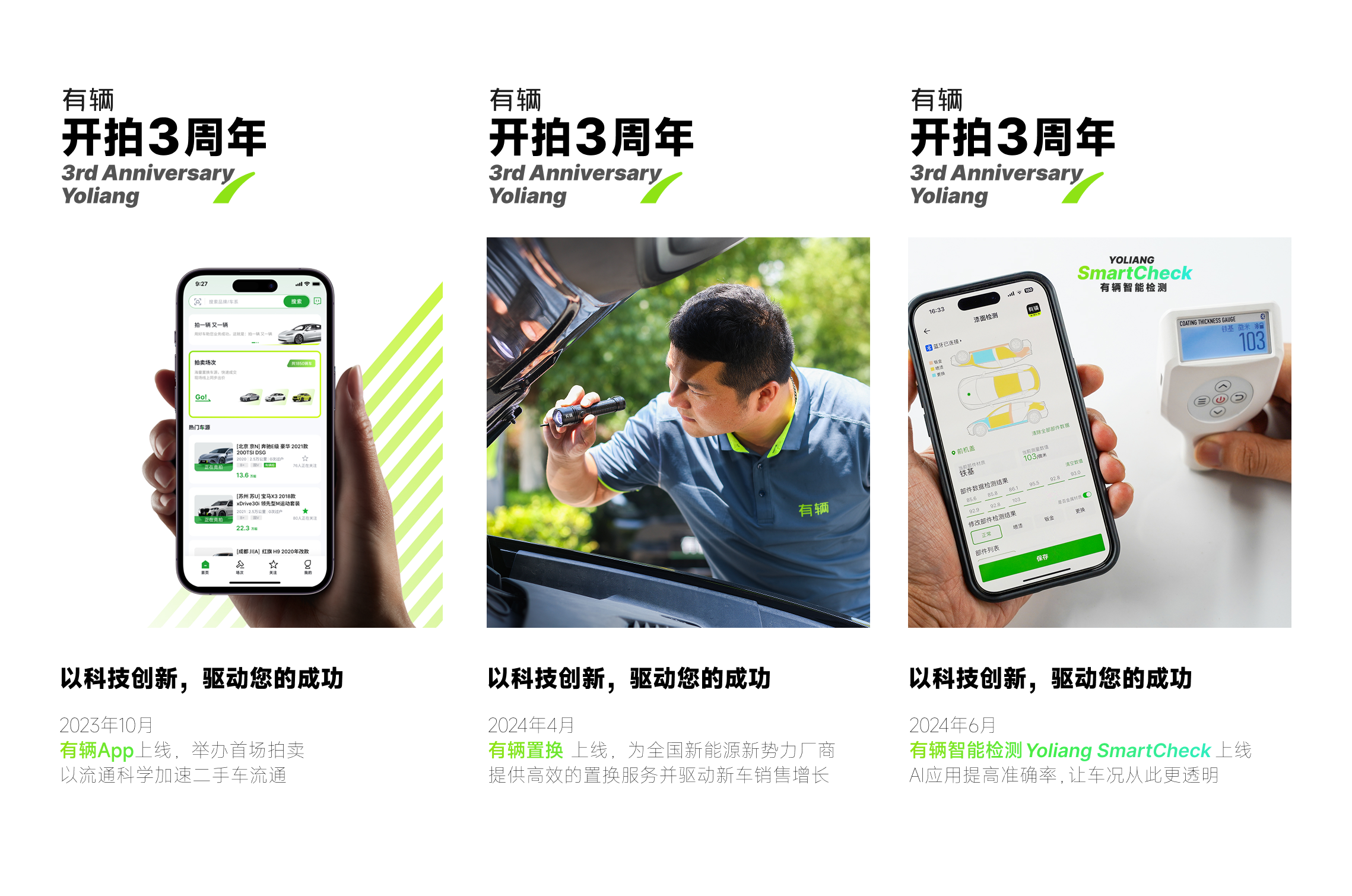
In October 2023, Yoliang’s core platform officially went live and hosted its first auction. By applying a data- and process-driven approach to used vehicle circulation, the platform sought to address information barriers and efficiency constraints within traditional used vehicle transactions, laying the foundation for digitalized transactions and beginning Yoliang’s technology-driven development journey.
As China’s new-vehicle replacement market continued to expand, particularly with the rapid growth of new energy vehicles, Yoliang launched its Yoliang Trade-In business in April 2024. The service was designed to support emerging new energy vehicle manufacturers nationwide by establishing an efficient and convenient trade-in system. It helps automakers manage trade-in inventory generated through new-vehicle sales while supporting new-vehicle sales growth, connecting the circulation of new and used vehicles and enabling closer coordination across the automotive value chain.
Using AI to Improve Vehicle-Condition Transparency
Vehicle-condition transparency is a fundamental requirement for the high-quality development of the used vehicle industry. To address information asymmetry surrounding vehicle condition, Yoliang launched Yoliang SmartCheck in June 2024.
Powered by AI-based algorithms, SmartCheck is designed to improve the accuracy and consistency of vehicle-condition assessments while converting inspection information into standardized and visualized digital data. The system addresses several long-standing challenges in used vehicle circulation, including vehicle authenticity, accuracy of condition assessments and the alignment between vehicle valuations and market conditions.
Through practical AI applications, Yoliang is building a more transparent approach to vehicle-condition assessment. SmartCheck is currently used by multiple automakers and leading automotive dealer groups in China. Its applications extend from vehicle acquisition through several key stages of the transaction process, supporting greater efficiency and service quality across used vehicle circulation.
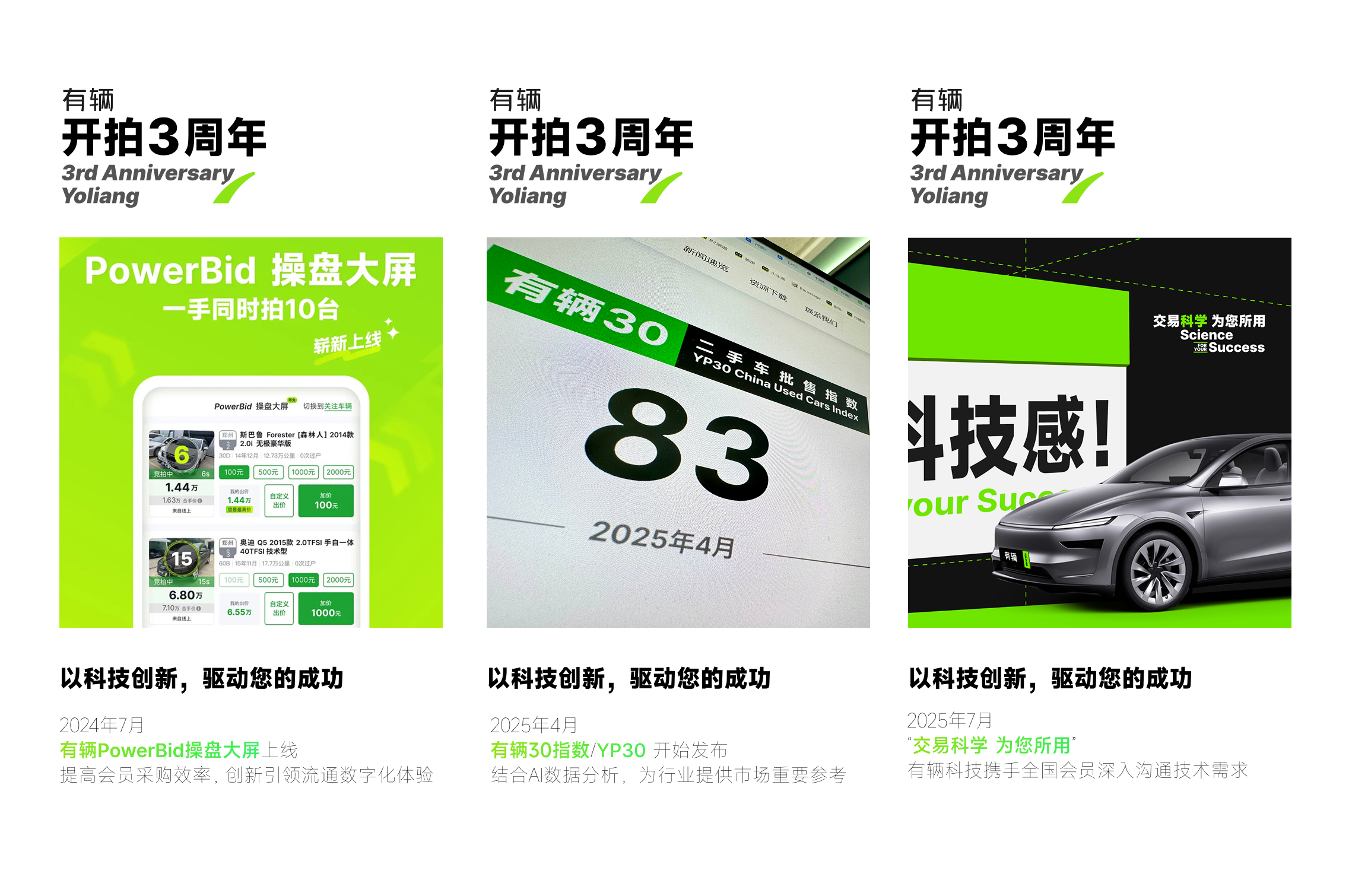
To address the low efficiency and operational complexity associated with bulk vehicle purchasing by professional dealers, Yoliang launched the PowerBid Dashboard in July 2024.
The system introduced a new digital purchasing experience for Yoliang members, allowing a single member to participate in simultaneous bidding for dozens of vehicles. By reducing the time required for vehicle sourcing and bidding, the system improves the efficiency of high-volume transactions and provides professional dealers with digital tools to support larger-scale operations.
The PowerBid Dashboard has become an important component of the Yoliang PowerBid Auction System and a key example of Yoliang’s efforts to improve the digital transaction experience across the used vehicle industry.
Turning Transaction Data into Market Intelligence
Yoliang has also continued to expand its application of AI and large-scale transaction data in market intelligence.
In April 2025, the platform officially launched the Yoliang 30 Used Vehicle Wholesale Price Index (YP30). Built on extensive transaction data and AI-powered analytical models, YP30 tracks changes in used vehicle wholesale prices, supply and demand, and broader market trends. It provides dealers, automakers and research institutions with a data-based reference for understanding market conditions and fills a gap in more granular market analysis for China’s used vehicle wholesale sector.
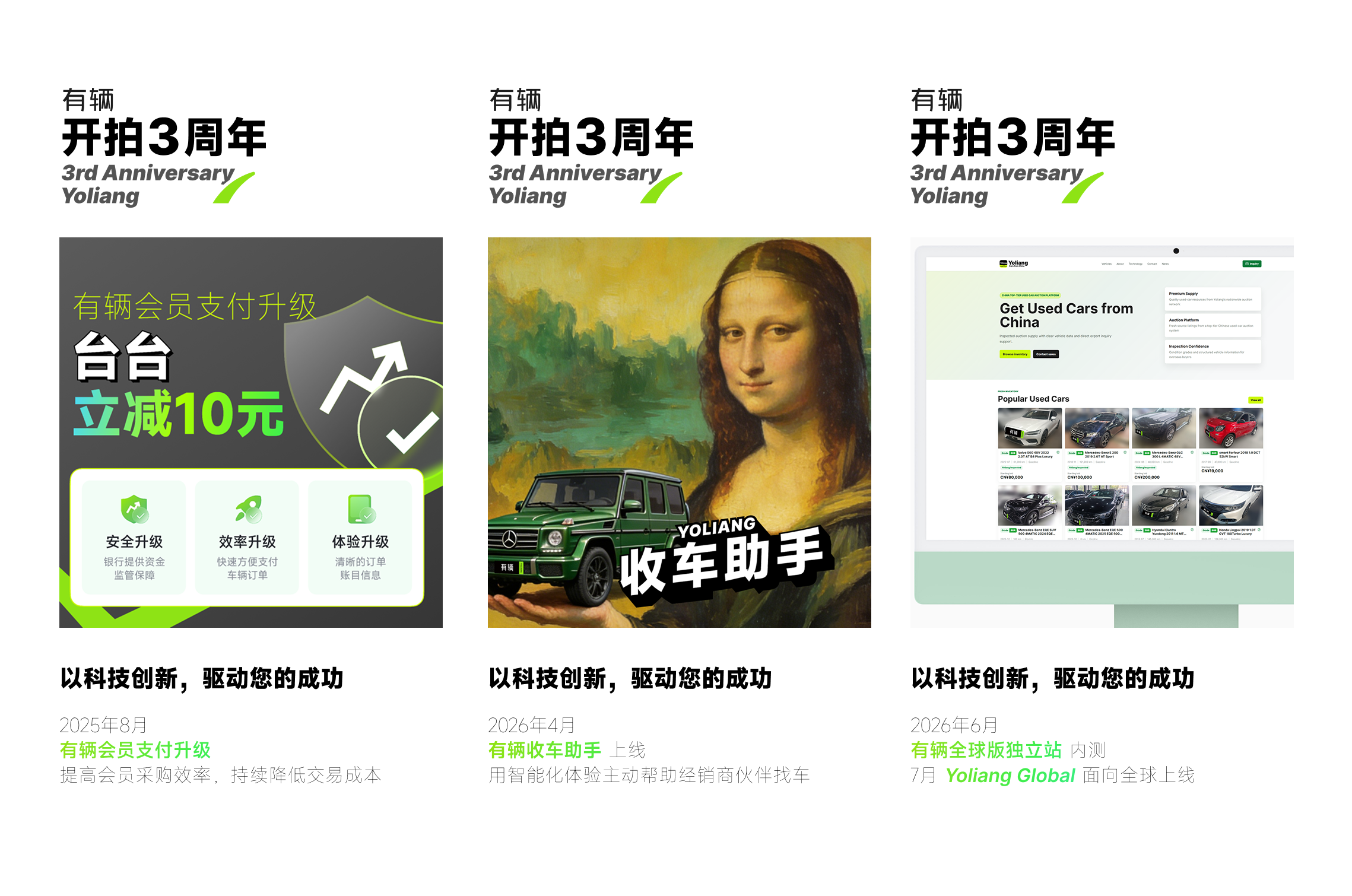
To further improve transaction services and reduce industry costs, Yoliang upgraded its member payment system in August 2025, helping reduce transaction-related expenses.
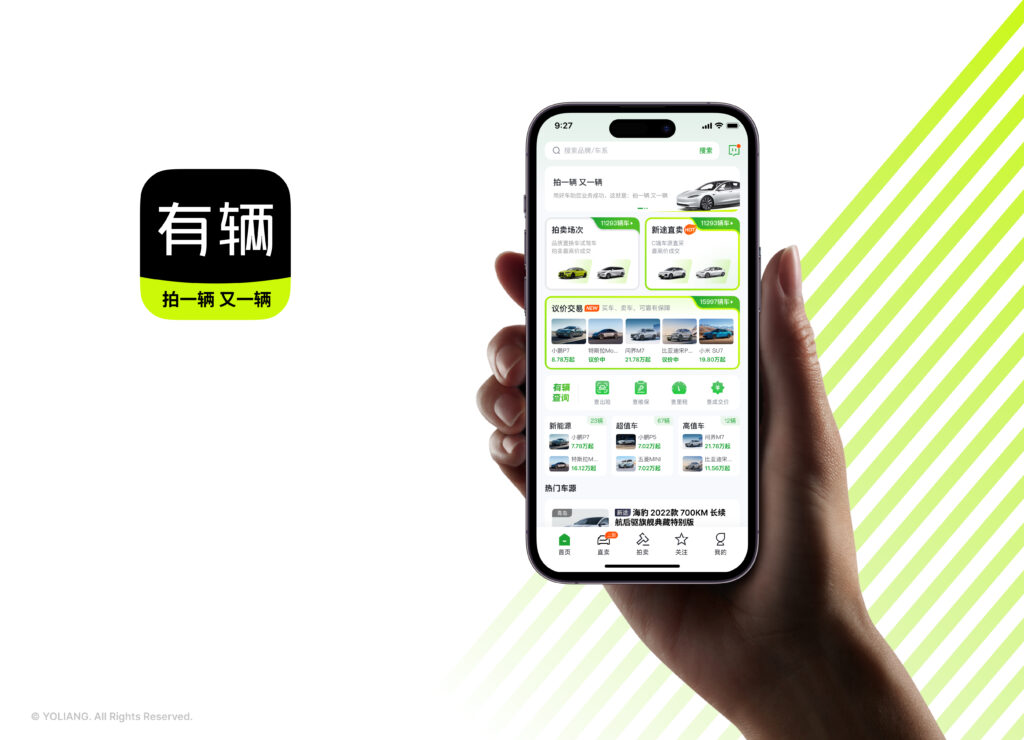
In April 2026, the company launched Vehicle Buyer Assistant, an intelligent sourcing tool designed around dealers’ vehicle procurement needs. Through proactive matching algorithms, the system identifies and recommends suitable vehicle inventory based on dealer requirements, helping dealers source vehicles more efficiently and improve operating efficiency.
Expanding Used Vehicle Circulation to Global Markets
As China’s used vehicle exports and international circulation continue to develop, Yoliang has also begun implementing its global strategy.
In June 2026, the Yoliang Global independent website entered internal testing, followed by its official global launch in July. The platform connects key stages of cross-border used vehicle transactions and provides overseas buyers with selected vehicle inventory accompanied by intelligent vehicle inspection reports.
By connecting quality used vehicle inventory from China with international buyers, Yoliang Global is extending the reach of China’s used vehicle circulation industry and creating additional channels for Chinese used vehicles to enter global markets.
Three Years of Continuous Innovation
Three years of technology-driven development have taken Yoliang from establishing a digital foundation for domestic used vehicle transactions, through the development of a full-chain product ecosystem, to the implementation of its global strategy.
Throughout this process, Yoliang has focused on technology as a core driver of its development, progressing from individual product and tool innovations to broader improvements in services, transaction infrastructure and used vehicle circulation technology. Each product and technology initiative represents an effort to put its original commitment into practice: using technology and innovation to help partners succeed.
Looking ahead from the new starting point of its third anniversary, Yoliang will continue to focus on digital used vehicle circulation, increase investment in core technology development, further strengthen its domestic service ecosystem and expand its global presence.
Through continued technological innovation and industry-focused services, Yoliang aims to support the used vehicle industry’s transition toward a more standardized, intelligent and internationally connected stage of development.
Yoliang 3rd Anniversary: A Timeline of Technology and Innovation
October 2023 Yoliang App Launches and Hosts Its First Auction Using a data-driven approach to accelerate used vehicle circulation.
April 2024 Yoliang Trade-In Launches Providing efficient trade-in services for emerging new energy vehicle manufacturers and supporting new-vehicle sales.
June 2024 Yoliang SmartCheck Launches Applying AI to improve inspection accuracy and enhance vehicle-condition transparency.
July 2024 Yoliang PowerBid Dashboard Launches Improving member purchasing efficiency and introducing a new digital transaction experience, with simultaneous bidding for up to 10 vehicles.
April 2025 Yoliang 30 Used Vehicle Wholesale Price Index (YP30) Begins Publication Combining transaction data and AI-powered analysis to provide an important market reference for industry participants.
July 2025 “Transaction Science, Works for You” Yoliang engages with members nationwide to better understand technology and transaction-service requirements.
August 2025 Yoliang Member Payment System Upgraded Improving purchasing efficiency while continuing to reduce transaction costs.
April 2026 Vehicle Buyer Assistant Launches Using intelligent matching to proactively help dealer partners source suitable vehicle inventory.
June 2026 Yoliang Global Enters Beta; Official Global Site Launch in July Connecting China’s used vehicle export business with overseas buyers and providing auction inventory accompanied by vehicle inspection reports.
About The Yoliang Company
The Yoliang Company is a technology-driven used vehicle circulation services platform focused on digitalizing and improving the efficiency of used vehicle transactions. Its business covers used vehicle auctions, trade-ins, vehicle inspection, transaction data services and cross-border used vehicle circulation.
Yoliang’s mission is to accelerate the trade of used cars through trustworthy and transparent services, using technology and data to improve efficiency, transparency and connectivity across the used vehicle value chain.
Translation Disclaimer: This English version is a translation of the original Chinese-language article. It is provided for reference and international communication purposes only. In the event of any discrepancy or inconsistency between the English translation and the original Chinese version, the original Chinese version shall prevail.