September 2026 YP30 Index Report: Price Declines Slow Significantly as Used Vehicle Market Enters a Structural Bottoming Phase
The Yoliang Company has released its September 2026 Yoliang 30 Used Vehicle Wholesale Price Index (YP30) report. The index remained at 65 points in September, broadly unchanged from August. The market has moved beyond the previous phase of sustained, sharp declines, with downward price pressure continuing to ease. The industry is entering a new phase characterized by tentative bottoming and increasing structural differentiation.
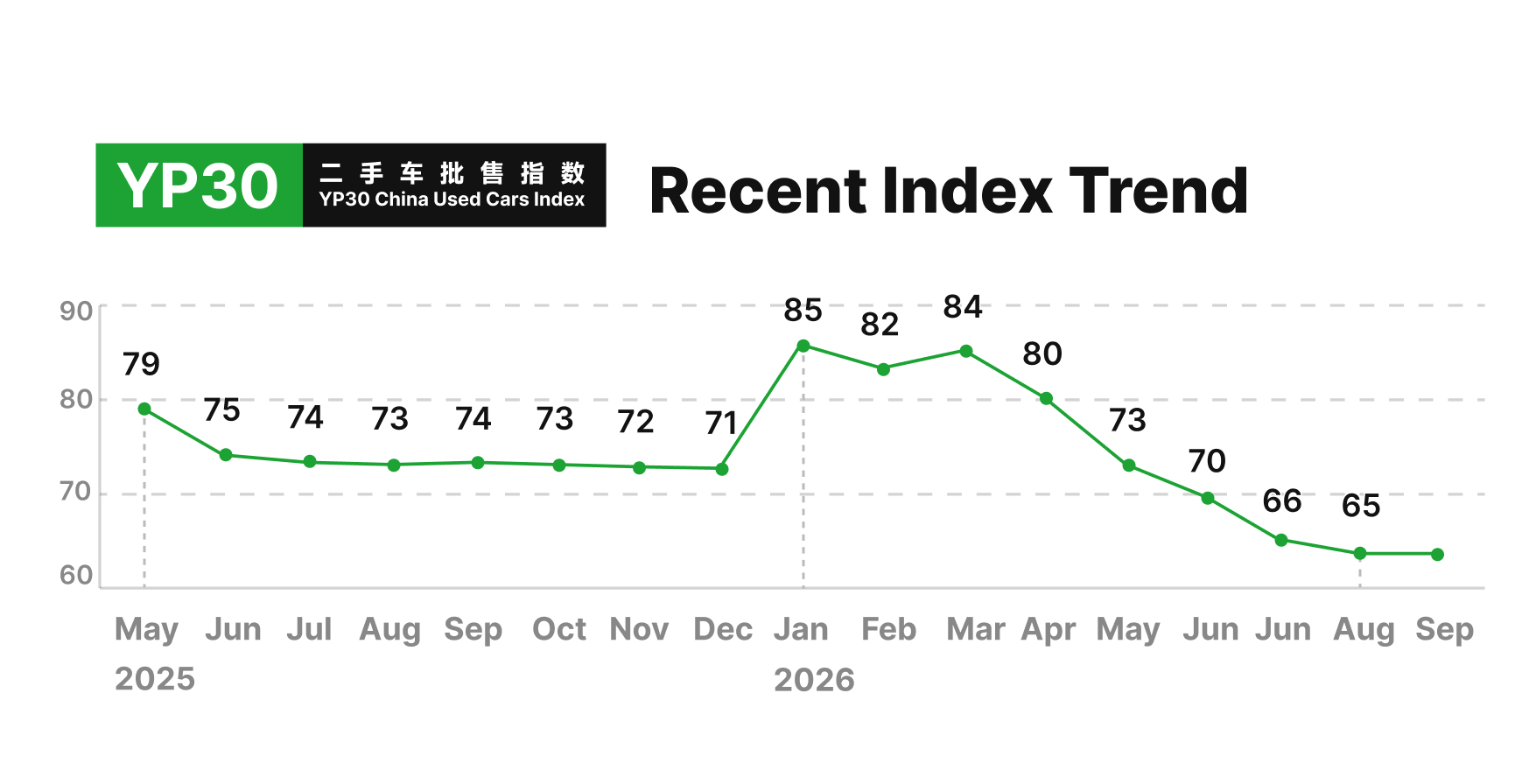
Market performance in July and August also pointed to a gradual moderation in price declines. As market sentiment begins to recover and September marks the traditional autumn peak season, trading confidence has shown signs of improvement. However, there is not yet clear evidence of a broad-based market rebound. The industry remains in a cautious recovery phase, with performance varying significantly across vehicle segments.
Macroeconomic Context: Used Vehicle Demand Remains Resilient
In the second half of 2026, the dynamics of China’s new and used vehicle markets continue to evolve. Used vehicle transactions have remained relatively stable, with used vehicle transaction volume equivalent to approximately 98% of new vehicle sales. China’s automotive market is increasingly entering a phase in which new and used vehicles coexist as major components of the overall market.
Continued price concessions in the new vehicle market and rising new energy vehicle penetration are placing sustained pressure on the valuations of used internal combustion engine vehicles. At the same time, used vehicles continue to benefit from their affordability and flexible circulation channels, absorbing replacement demand and demonstrating resilience. These factors provide underlying support for market stabilization.
Price Trends: From Broad-Based Declines to Structural Differentiation
The Yoliang 30 Index reached an annual high of 84 points in March 2026 before declining through the following months. The pace of decline moderated in July and August, with August recording the smallest monthly decrease of the year. In September, the index stabilized, indicating that near-term downward pressure had eased considerably.
The market is not yet experiencing a broad-based recovery. Instead, it is shifting from widespread price declines toward structural differentiation and selective recovery. Price performance varies substantially by vehicle type, segment and brand, creating divergent opportunities and risks for used vehicle dealers.
Vehicle Types: Sedans Remain Resilient, While SUVs and MPVs Face Continued Pressure
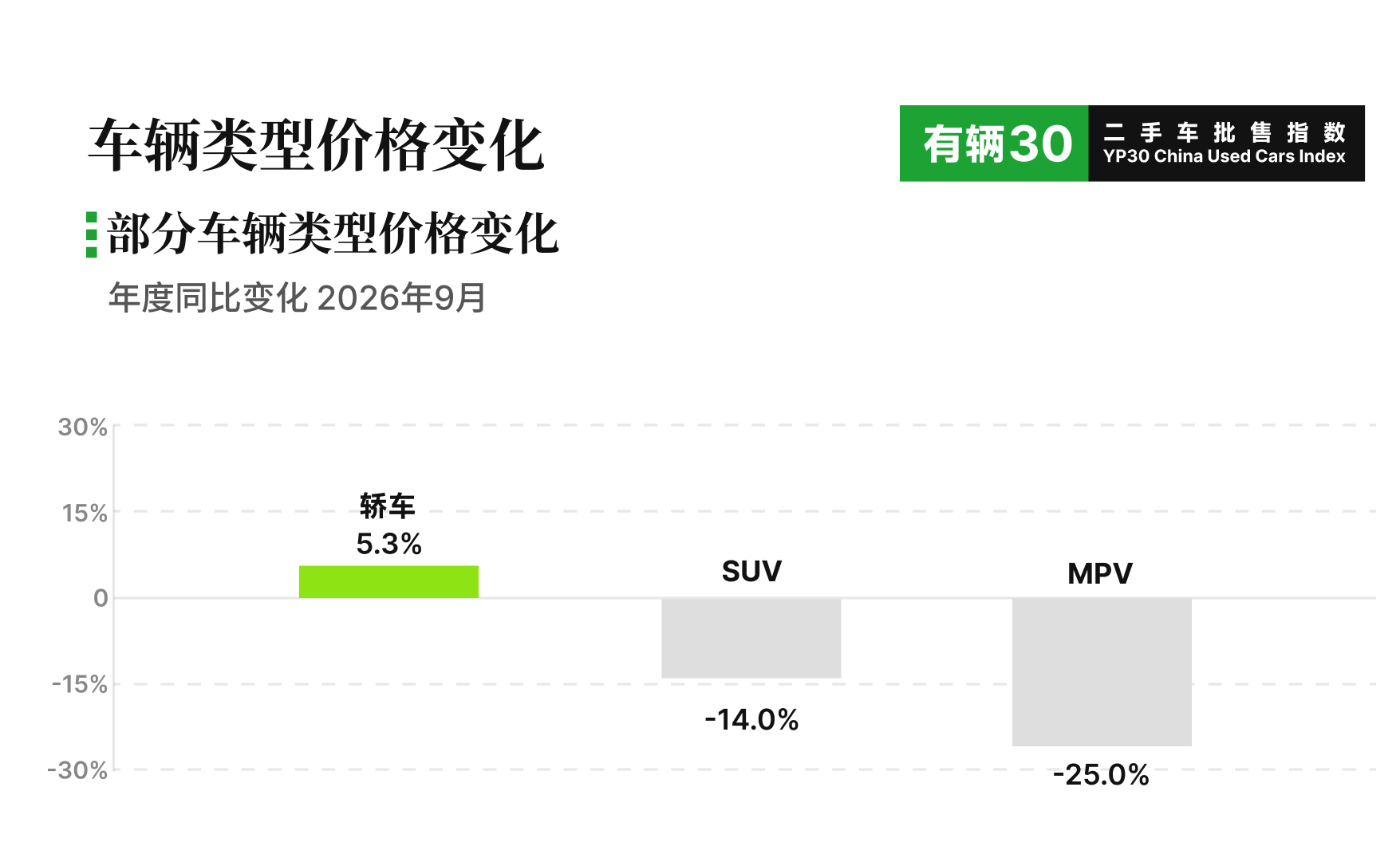
Price performance across vehicle types remained notably differentiated in September.
Sedans were the most resilient category, with prices rising 5.3% year over year. Their broad customer base, relatively high turnover and stable demand make mainstream passenger cars a comparatively defensive inventory choice for dealers.
SUVs and MPVs continued to face pressure. SUV prices fell 14.0% year over year, while MPV prices declined 25.0%. Factors include continued price cuts in the new vehicle market, changing household mobility needs and abundant existing inventory. Residual values for larger business-oriented and multipurpose family vehicles are recovering more slowly, leaving these categories relatively exposed to market risk.
Vehicle Segments: Strength at Both Ends of the Market
Data by vehicle segment show a distinctly polarized pattern in September.
Micro and mini vehicles used for everyday mobility performed particularly well, with prices increasing 42.4% year over year. Demand for affordable transportation and low-cost vehicle ownership continues to support this segment, which also benefits from relatively efficient inventory turnover.
Larger and premium used vehicles also recovered, with prices rising 34.0% year over year. This reflects a gradual recovery in high-end replacement demand and improving valuations for premium vehicles in good condition.
Small and compact vehicles recorded modest gains, while mainstream midsize vehicles remained broadly stable, with limited price movements.
Overall, demand and purchasing activity are increasingly concentrated at two ends of the market: highly affordable vehicles for everyday mobility and premium vehicles in good condition. Mainstream family vehicles in the middle of the market are entering a more stable phase, with neither strong upward nor downward momentum.
Brand Origins: Chinese Brands Gain Ground as Valuations Recover
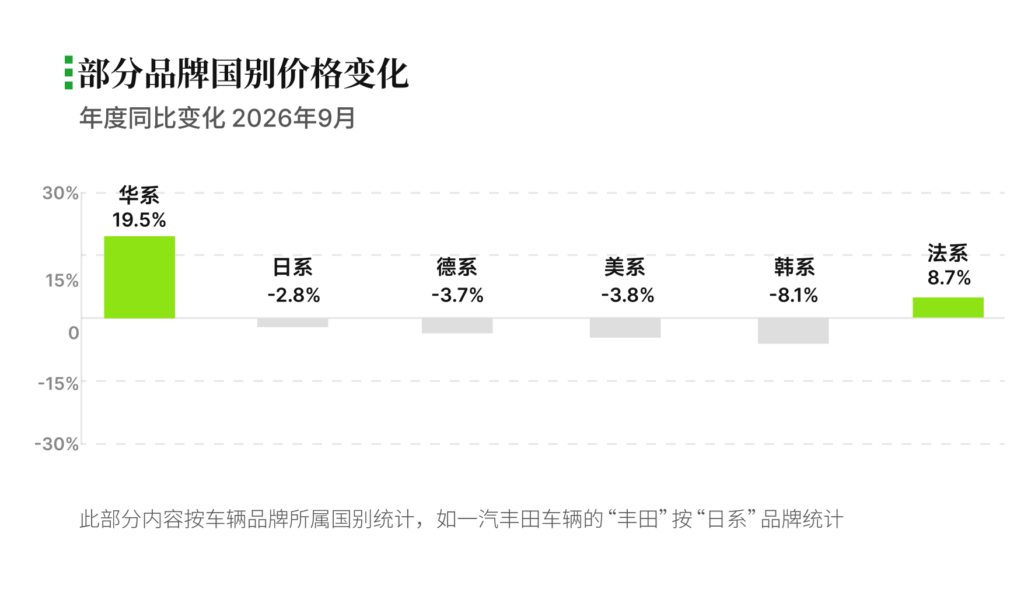
The brand valuation landscape underwent a notable shift in September, with Chinese domestic brands recording a strong recovery.
Used vehicles from Chinese brands rose 19.5% year over year, outperforming other brand-origin categories. Continued advances in new energy vehicle technology, a growing vehicle population and improvements in after-sales service are supporting stronger residual values and consumer acceptance of Chinese vehicles. This signals a gradual reshaping of a valuation landscape historically dominated by joint-venture brands.
French brands also performed relatively well, rising 8.7% year over year. Japanese, German and American brands recorded modest declines, while Korean brands faced the greatest pressure, with prices falling 8.1% year over year.
The changing performance of domestic and joint-venture brands represents one of the most significant structural developments in China’s used vehicle market in September.
Cross-Regional Circulation: Strong Northern Demand, with Central China Gaining Momentum
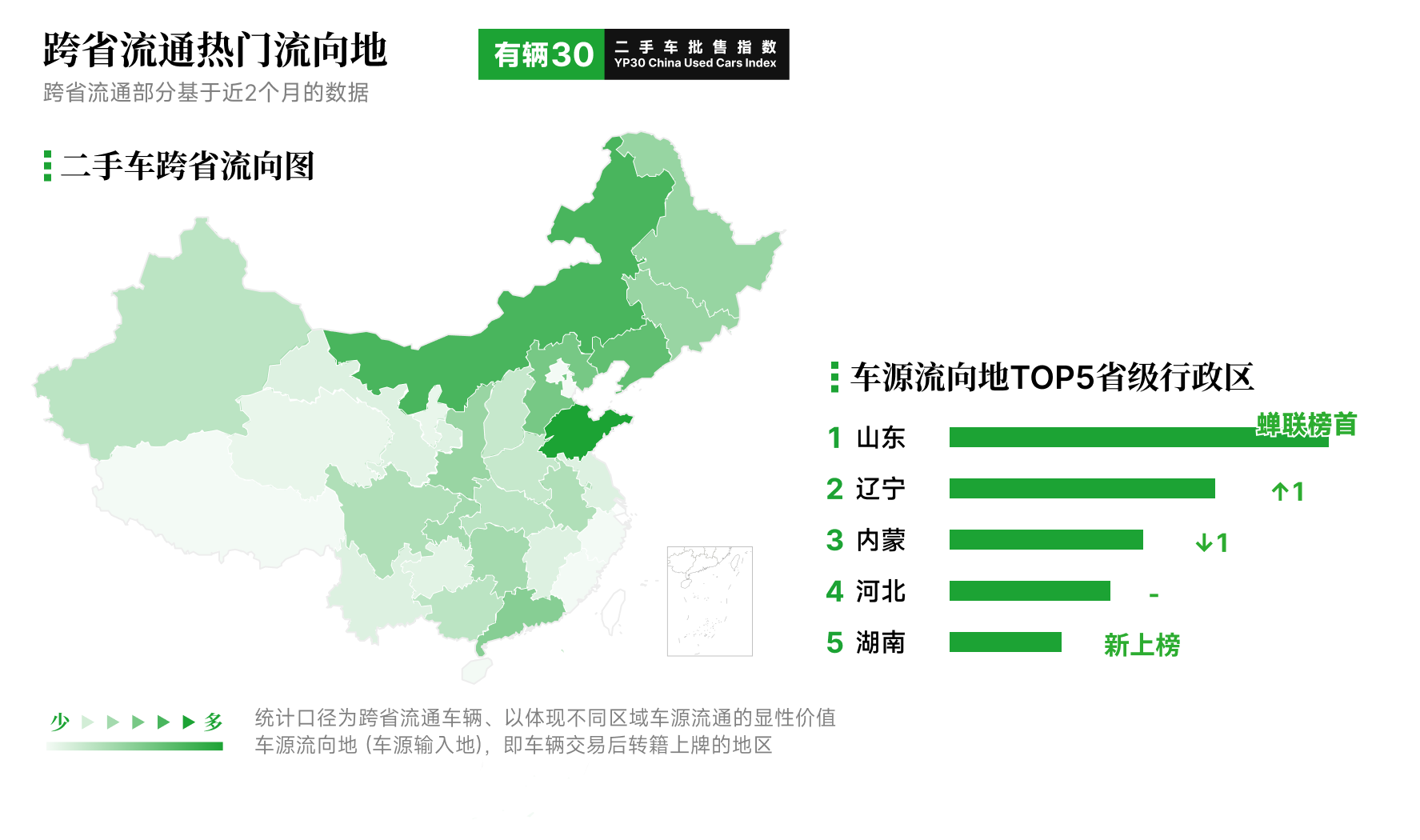
Interprovincial used vehicle circulation remained active, helping balance differences in supply and demand across China. Over the past two months, the top five provinces by vehicle inflows were Shandong, Liaoning, Inner Mongolia, Hebei and Hunan.
Shandong remained the country’s largest vehicle-inflow market. Demand across northern China remained strong, particularly for family-oriented internal combustion engine vehicles and practical everyday cars. Hunan entered the top five, indicating growing purchasing demand in central China and a further expansion of the national used vehicle circulation network.
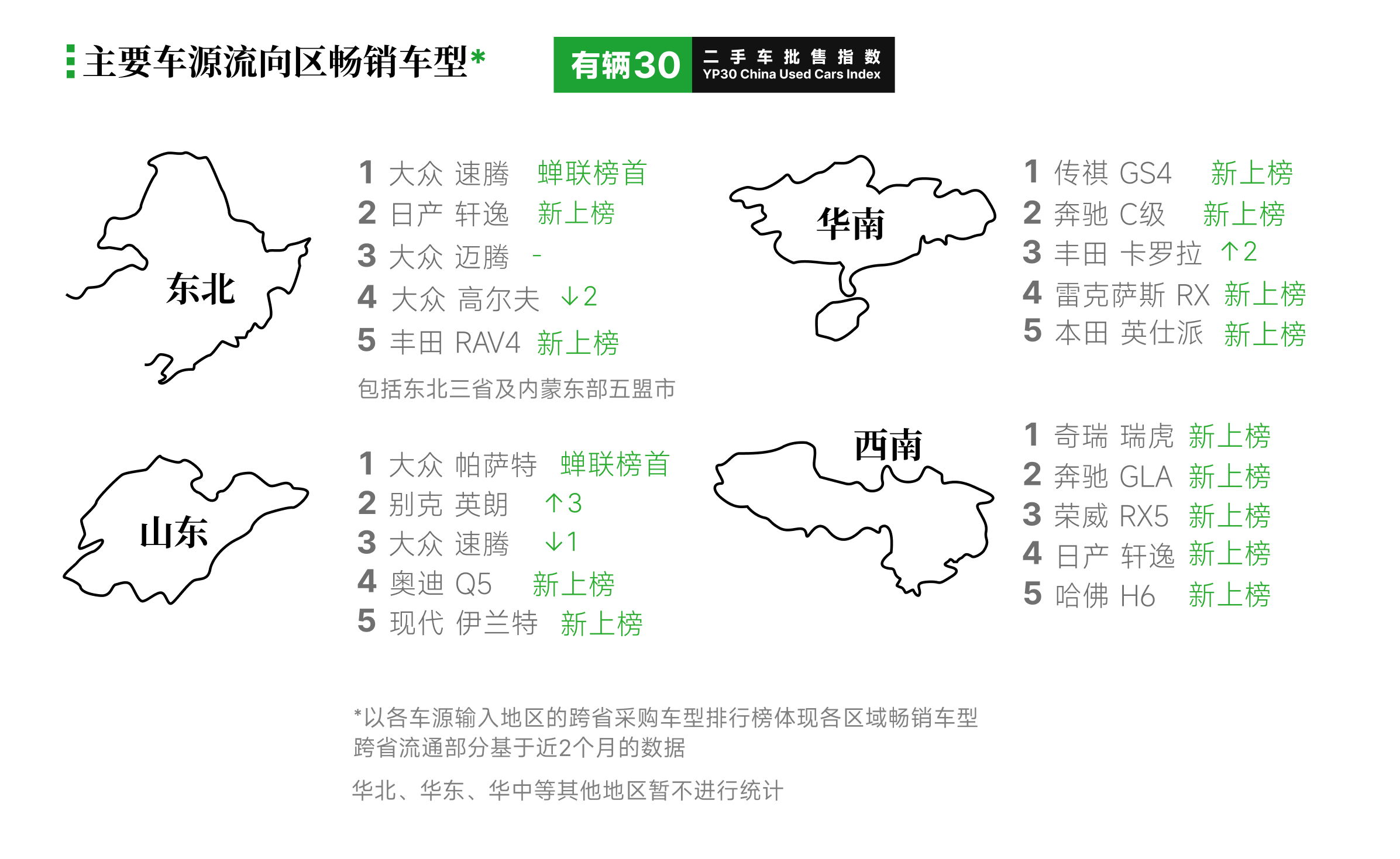
Popular models also reflected distinct regional preferences:
- Northeast China: The Volkswagen Sagitar remained a leading model, supported by established demand for German family cars, while Japanese SUVs continued to gain traction.
- Shandong: The Volkswagen Passat maintained a leading position, highlighting the continued importance of mainstream joint-venture family vehicles.
- South China: Domestic and luxury brands performed well, with the GAC Trumpchi GS4, Mercedes-Benz C-Class and Lexus RX among the region’s popular models.
- Southwest China: Domestic SUVs gained traction, with the Chery Tiggo, Haval H6 and Roewe RX5 recording stronger circulation performance.
These regional differences continue to support nationwide used vehicle liquidity by connecting inventory with markets where demand is strongest.
Exports Provide Additional Support as Digital Channels Connect Global Markets
As China’s domestic used vehicle market undergoes structural adjustment, exports continue to provide an additional source of demand and support residual values in selected segments.
China’s used vehicle exports maintained steady growth in July and August. Demand continued to emerge from Central Asia, Russia, Southeast Asia, the Middle East and Africa. Overseas orders remained active for compliant, affordable internal combustion engine vehicles and high-quality used new energy vehicles. Export demand helps absorb domestic inventory, ease supply pressure and support prices in selected segments.
Although exports alone are unlikely to generate a broad-based price recovery across the entire domestic market, they help improve the balance between supply and demand and contribute to a more stable market adjustment.
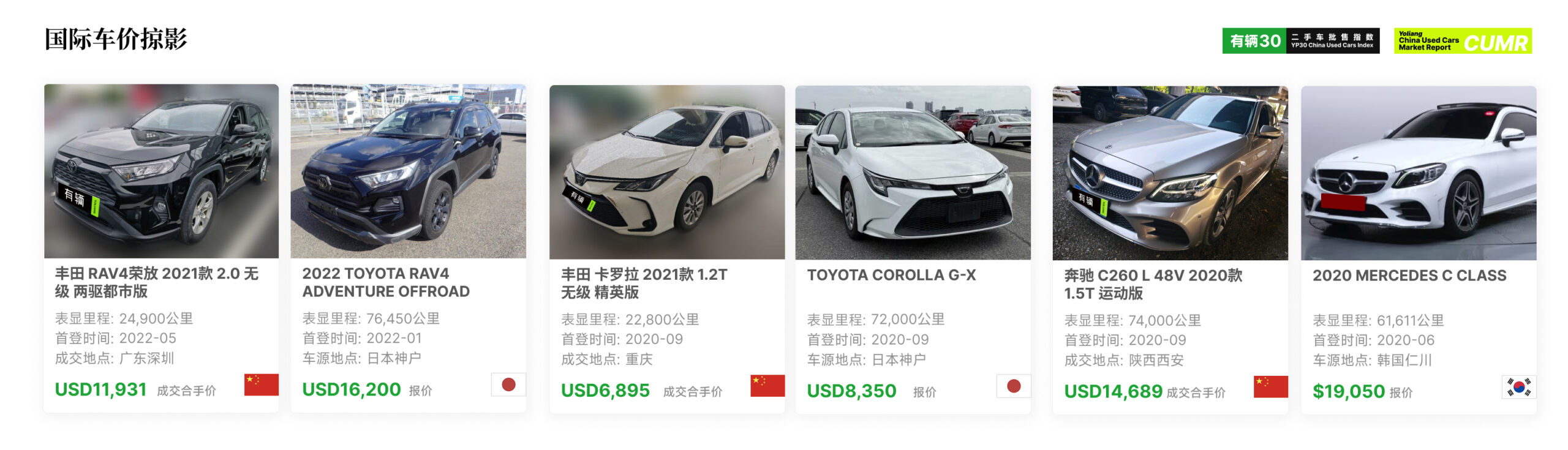
Against this backdrop, The Yoliang Company continues to develop its digital cross-border services through Yoliang Global, its independent international platform. The platform provides international buyers across multiple countries with round-the-clock access to used vehicle inventory in China, including actual auction listings, vehicle-condition records, photographs and relevant documentation.
By improving access to vehicle information and reducing information gaps in cross-border transactions, Yoliang Global helps overseas buyers evaluate and select vehicles remotely. It also enables Chinese exporters and wholesalers to connect more efficiently with international buyers, supporting more efficient cross-border circulation and the international expansion of China’s used vehicle trade.
September Market Insights and Outlook
Taken together, market data from July through September and broader economic developments indicate that China’s used vehicle market has moved beyond the period of sharp declines and entered a phase of tentative bottoming, structural differentiation and cautious recovery. The easing of price declines and the arrival of the traditional autumn peak season have helped improve business confidence.
Nevertheless, a sustained upward turning point has not yet been established. New vehicle price competition, elevated inventory in certain segments and uneven recovery in consumer demand continue to weigh on the market. A broad-based rise in used vehicle prices is therefore not yet supported by current conditions.
Several segment-specific opportunities are becoming clearer. Micro and mini vehicles, larger premium vehicles and used vehicles from Chinese domestic brands have demonstrated stronger price performance or residual-value resilience. By contrast, dealers should remain cautious when stocking traditional SUVs, MPVs and weaker-performing joint-venture brands.
As the traditional September–October peak season progresses, continued implementation of vehicle trade-in programs and the release of replacement demand could help improve inventory turnover and strengthen the foundations for a gradual recovery.
Overall, September 2026 was characterized by slowing price declines, bottoming-out movements, structural differentiation and incremental support from exports. China’s used vehicle market is moving away from a broad-based downward adjustment toward a new phase focused on optimizing existing inventory and drawing on both domestic demand and international markets.
Whether the market can establish a sustained rebound will depend on the combined signals from transaction volumes, inventory turnover, new vehicle pricing strategies and export orders in the months ahead.
About Yoliang
The Yoliang Company is a technology-driven used vehicle circulation services platform focused on improving the efficiency and transparency of used vehicle transactions. Its business spans used vehicle auctions, vehicle inspection, transaction data services and cross-border used vehicle circulation.
The Yoliang 30 Used Vehicle Wholesale Price Index (YP30) tracks wholesale price movements across 30 mainstream vehicle models, using Yoliang’s transaction data and analytical methodology to provide market reference information for industry participants.
Translation Disclaimer: This English version is a translation of the original Chinese-language article. It is provided for reference and international communication purposes only. In the event of any discrepancy or inconsistency between the English translation and the original Chinese version, the original Chinese version shall prevail.